
Downsizing Checklist for Seniors: A Room-by-Room Plan for the Whole Move

A practical downsizing checklist for seniors and the families helping them, built from hundreds of real Bradenton and Sarasota cleanouts.
Older woman and her adult daughter planning a home downsizing project at a kitchen table in Bradenton, FL

We Answer Every Call | Real People, No Callback Queue

Same Day or Next Day | Most Jobs Scheduled Within 24 Hours

Fully Insured | COI Available on Request

Family Run Since 2020 | Bradenton-Based Crew of Four

Three Decisions to Make Before You Open a Single Closet

Almost everyone starts a senior downsizing checklist in the wrong place, usually the attic or the garage, because that’s where the obvious clutter lives. The problem is that sorting without a target means you’re guessing about every single item, and guessing is exhausting. These three decisions come first, and once they’re settled, most of the sorting answers itself.

Measure the New Space First, Then Work Backward

Get the floor plan, or get a tape measure into the new place and write down the actual dimensions of every room, closet, and storage area. Then measure the furniture you assume is coming with you. A sectional that anchored a 20-foot living room rarely fits a one-bedroom apartment or an assisted living suite, and finding that out on moving day is a bad afternoon for everyone. Families who do this step early tell us it cut their decision-making time roughly in half, because “does it fit” is a much easier question than “do I love it.”

Pick the Move Date, Then Count Backward in Weeks

A move date turns an overwhelming project into a sequence. Twelve weeks is comfortable, eight weeks is workable, and four weeks is tight but survivable if you’re willing to make faster calls and hire help for the heavy parts. Write the date at the top of the list, then assign each room to a week. If the date is still soft because you’re waiting on a closing or a room to open up at a community, use your best guess and adjust, since a working timeline beats no timeline every time.

Decide Who Is Actually Doing This Work

Be honest about who is available, and how often. One adult child who lives forty minutes away and works full time is not going to clear a four-bedroom house on weekends, no matter how willing they are. Some families bring in a senior move manager to run the process, some split rooms between siblings, and plenty do the sorting themselves and hire out only the hauling. Name the people, name their hours, and put it in writing so nobody is quietly assuming somebody else is handling the garage.

Sorting Room by Room Without Burning Out in Week One

This is the longest phase and the one where most people stall. Pace matters more than speed here, and the order you work in changes how hard the whole thing feels.

Use Four Categories, Not Two

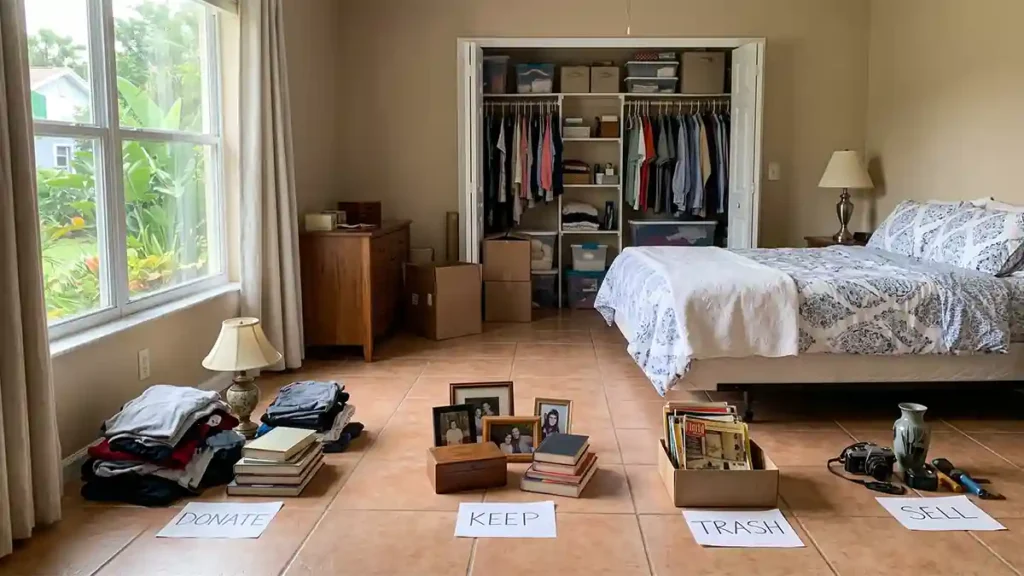
Keep, give, sell, and go. Four labeled zones, one room at a time, and every item lands in exactly one of them before you move on. The reason two-pile systems fail is that “maybe” quietly becomes a fifth pile that grows all month and gets dealt with at midnight the day before the truck comes. If an item genuinely needs a family conversation, put it in “give” with a sticky note naming the person who gets the call, so it still has a destination.

Start With Storage, Save the Bedroom for Last

Garages, sheds, spare closets, and the back of the pantry are the easiest places to begin because the emotional weight is lower and the wins are visible fast. Bedrooms, photo albums, and anything belonging to a spouse who has passed should come last, after you’ve had weeks of practice making decisions and built some momentum. This is the single most useful of the downsizing tips for seniors that we pass along, and it comes straight from watching families do it both ways.

Photograph Anything With Value Before It Moves
Take a photo of every piece of jewelry, artwork, collection, tool set, and antique before it leaves the house, along with a quick note on where it came from and where it’s going. Insurance carriers want documentation on high-value items being moved or stored, family members want to know what happened to grandpa’s watch, and estate attorneys sometimes need a record of what was distributed and when. Ten minutes with a phone camera per room prevents most of the arguments that come up six months later.
Belongings sorted into four labeled zones while working through a downsizing checklist for seniors

What Donation Centers Will and Will Not Take in Manatee and Sarasota Counties

This is the step that surprises almost every family we work with. The assumption is that Salvation Army, Goodwill, or Habitat for Humanity ReStore will take the bulk of a house because so much of it is still perfectly usable, and then the reality of donation intake rules lands in the middle of moving week.

Call Ahead, Because the Rules Are Stricter Than You Remember

Most centers now require a scheduled pickup appointment for furniture, and those appointments book out weeks in advance during snowbird season. Even with an appointment, the driver can decline items at the curb if they don’t meet condition standards, and there is no appeal. Call the specific location you plan to use, ask what they’re currently accepting, and ask how far out their pickup calendar runs. Getting a real answer in week two is the difference between a smooth donation plan and a living room full of furniture on closing day.

Usually Accepted, Usually Declined

Rules vary by location and change seasonally, so treat this as a starting point rather than a guarantee.

Usually accepted:

Usually declined:

Plan for the Percentage That Nobody Wants

Even in a well-kept home, a meaningful share of the contents has no donation home, no resale value, and no family member waiting on it. That’s not a judgment about the house or the person who lived in it, it’s just how household goods age. Budget for that portion in your timeline and your costs from the start, because families who assume donation will absorb everything are the ones scrambling in the last seventy-two hours.

Selling, Gifting, and the Honest Math on Resale Value

Two things are true at once here: some items are genuinely worth selling, and most items are worth far less than the family expects. Anyone researching how to downsize before moving runs into that gap eventually, and sorting out which is which early saves weeks.

Ask the Family in Writing, and Set a Deadline

Send one message to everyone who might want something, list what’s available with photos, and give a firm date by which they need to claim it and arrange to pick it up. Verbal claims made at Thanksgiving do not survive contact with a moving timeline. Put the deadline two weeks before the move, not two days, so there’s room to redirect anything nobody claims into the sell or donate pile without a crisis.

When an Estate Sale or Consignment Actually Pays Off

Estate sale companies typically take a percentage of gross sales and want enough sellable inventory to justify staffing a weekend, so a home with genuine antiques, collections, tools, or mid-century furniture is a reasonable candidate. A home furnished mostly in the last twenty years from big-box retailers usually is not, and a company that agrees to run that sale anyway may leave you with cleanup costs that exceed the check. Consignment works better for a small number of high-value pieces, though most shops take sixty to ninety days to sell and only accept what they believe moves.

The Furniture Nobody Warns You About

Brown wood furniture, china cabinets, formal dining sets, and full china services have almost no resale market right now, and that surprises families more than anything else on this list. These pieces were expensive, they were cared for, and they meant something, so hearing they’re hard to give away lands badly. It’s worth knowing before you spend three weeks trying to sell a dining set that a decluttering checklist for seniors should have routed to donation or haul-away in week one.

The Paperwork Step Almost Every Senior Move Checklist Skips

Physical items get all the attention, and then somebody needs a birth certificate for an assisted living application and nobody knows which box it went into.

Pull These Documents Out First and Keep Them With You

Before any sorting starts, gather the deed or lease, insurance policies, Social Security cards, birth and marriage certificates, military discharge papers, wills and trust documents, powers of attorney, healthcare directives, current medication lists, tax returns for the last several years, and vehicle titles. Put all of it in one clearly marked box or folder that travels in a car, never on the truck. Rebuilding these records after they go missing takes months and, in a few cases, cannot be done at all.

Photograph the House Before It Empties

Walk every room and take video or photos of the full contents while the house is still furnished. Insurance carriers use it if something is damaged or lost in transit, and families use it later to settle honest disagreements about what was in the home. It takes fifteen minutes and it’s the cheapest insurance in the entire process.

Handle the Address Changes on a Schedule

Change of address with the postal service, then Social Security and Medicare, then banks, insurance carriers, the pharmacy, the primary care office, and any subscription that ships something to the door. Utilities need a scheduled shutoff or transfer date rather than an immediate cancellation, since you’ll want power and water on for the final clearing and cleaning after the furniture is gone. Work through it over two or three sittings rather than one, because this is the step that gets rushed and then produces a missed prescription refill in the first week at the new place.

The Downsizing Checklist for Seniors at a Glance

Twelve Weeks to Move Day

Here’s the whole sequence in one view. Print it, tape it inside a cabinet door, and cross off rooms as they finish.
TimelineFocusWhat Gets Done
12 weeks outPlanMeasure the new space, set the move date, assign who does what
10 weeks outStorage areasGarage, shed, spare closets, pantry back stock
8 weeks outDonationsCall centers, book pickup appointments, confirm what they accept
8 weeks outFamilySend the claim list with photos and a firm pickup deadline
6 weeks outLiving areasLiving room, dining room, den, guest rooms
6 weeks outSalesBook the estate sale or consignment drop-off if you're using one
4 weeks outDocumentsGather records, photograph contents, start address changes
4 weeks outHaul-awayGet a quote and hold a date for the final clear-out
2 weeks outBedroomsPersonal rooms, photos, keepsakes, anything emotionally heavy
1 week outConfirmReconfirm movers, haulers, utilities, and the first-night box
Move weekClear outMovers first, then the crew hauls what's left, then final clean

If Your Move Date Is Closer Than Twelve Weeks

Compress from the top, not the bottom. The planning week and the storage-area week can collapse into a few days if you’ve got help, and family claims can run on a one-week deadline instead of two. What you should not compress is the documents step or the haul-away booking, since paperwork mistakes follow you for months and crews book out fastest at the end of the month. Families working a three-week timeline usually keep less, donate less, and haul more, and that’s a reasonable trade when the calendar is fixed.

The Last Fourteen Days: What Order Everything Happens In

Most of a downsizing checklist for seniors is about decisions, and the last fourteen days are about sequence instead. Getting that order wrong is what creates the moving-day scramble.

Pack the First-Night Box and Guard It

Medications, a change of clothes, toiletries, phone chargers, glasses, hearing aid batteries, a few dishes, and the document folder. This box rides in a car with a person, not on a truck. Label it on all six sides so it doesn’t get absorbed into the general stack, because the first night in a new place is hard enough without hunting for a toothbrush at ten at night.

Reconfirm Every Vendor by Phone

Call the movers, the haulers, the utility companies, the donation pickup, and the cleaning crew in the same sitting, roughly seven days out. Ask each one to confirm the date, the arrival window, and what they need from you on site. Vendors do drop appointments, and finding out a week early gives you time to solve it, while finding out on the morning of the move gives you nothing.

Movers First, Haulers Second, Cleaners Last

Run it in that order. The movers take what’s going to the new home, the junk removal crew clears everything left behind, and the cleaning crew comes into an empty house. Booking the hauler before the movers finish creates a crew standing around a half-packed house, and booking cleaners before the hauler means they’ll clean around furniture that’s still leaving. If a real estate closing is attached to the date, tell every vendor that up front so they know the deadline is real.

When to Call a Junk Removal Crew, and What That Step Costs

Every downsizing checklist for seniors ends at the same place. The family has taken what they want, the donation truck came and went, the estate sale is over, and there’s still a house with contents in it and a deadline attached. That’s the step we handle.

What's Usually Left at This Point

Furniture that didn’t sell and couldn’t be donated, mattresses, garage and shed contents, old exercise equipment, tube televisions, filing cabinets full of paper, holiday decorations, patio furniture, and the general room-by-room remainder that never fit a category. We load all of it in one trip when the volume allows. For a full home being cleared at once, our estate cleanout service covers the whole property, including the garage, the shed, and any outbuildings, and it’s the same crew doing all of it.

What the Final Clear-Out Costs

Our pricing is published rather than quoted room by room, so you can plan around it. Jobs start at a $165 minimum, which covers roughly a pickup-truck load, and larger jobs are priced by load fraction: a quarter load runs $225, a half load $450, and a full load $900, with the sizes in between priced accordingly. Standard pricing covers up to one ton, and anything over that is prorated at $85 per ton. If you need labor without hauling, such as moving items between rooms or staging a garage, that’s $85 per hour. The full breakdown lives on our junk removal cost page if you want to build a number into your moving budget before you call.

How Fast We Can Get There

We answer every call, which sounds like a small thing until you’ve called five companies and reached four voicemails. Most jobs get scheduled same day or next day, and if we genuinely can’t hit your deadline we’ll tell you that on the phone instead of leaving you waiting on a callback. We’re fully insured with a COI available on request, which some communities and property managers require before a crew comes on site. Call (941) 354-5865 and tell us your date, and we’ll work backward from it the same way you did.
Manatee Junk Bros crew clearing the last household items from a Bradenton home after a senior downsizing move

If You're Managing Your Parent's Move From Another State

A large share of the families who call us are adult children handling this remotely, often between work and their own households. Downsizing a parent’s home from a thousand miles away is a different project with a different set of failure points. Every step of the downsizing checklist for seniors above still applies, though the coordination layer sitting on top of it is where remote moves usually break down.

Give One Person Decision Authority, in Writing

Siblings splitting decisions by group text is how a two-month project becomes a six-month project. Agree early on who makes the final call on what stays, what sells, and what gets hauled, and put it in an email everyone can point back to. That person should also be the single point of contact for every vendor, since three siblings calling the same mover with different instructions produces exactly the outcome you’d expect.

Work With People Who Will Actually Pick Up the Phone

Remote coordination only works if the vendors on the ground answer when you call and tell you the truth about timing. We schedule around real estate closings and community move-in dates regularly, we send confirmation when a job is finished, and we’ll walk a property and give you an honest read over the phone if you can’t be there. Build in more time than you think you need, though, since flights get moved, closings slip, and the one week you set aside to handle everything in person always turns out to be tighter than it looked on the calendar.

Questions Families Ask Us Every Week About Downsizing

How far in advance should we start downsizing?

Twelve weeks is comfortable for a full house. Eight is workable. Under four weeks you’ll keep less and haul more, which costs more but still gets done.

Yes, and it’s actually the most common version of this move we see. The main difference is scale, since an assisted living suite or a memory care room holds a fraction of what a house does, which means the keep pile is very small and the timeline is often compressed because rooms open on the community’s schedule rather than yours. Measure the room first, confirm what the community allows in terms of furniture, appliances, and wall hangings, and plan for most of the household to go to family, donation, or haul-away.

That’s the haul-away step. Once family has claimed what they want and the donation center has taken what it will accept, a junk removal crew clears the rest in one or two trips. We handle full-house clear-outs across Bradenton, Sarasota, Lakewood Ranch, Parrish, Palmetto, and Ellenton, and we can usually be there same day or next day.

Sometimes, with a scheduled appointment, and their calendars fill up weeks out during the winter season here. Even with an appointment booked, the driver can decline items at the curb if the condition doesn’t meet their standards, and mattresses and upholstered furniture are declined almost universally. Call the specific location before you count on it.

It depends on volume. Our jobs start at a $165 minimum for roughly a pickup-truck load, and full-house clear-outs are priced by load fraction, running from $225 for a quarter load up to $900 for a full load, with pricing that covers up to one ton and $85 per ton beyond that. We give you a real number before the crew starts, and if we find significantly more than the estimate covered, we tell you and give you a revised price before loading anything extra.

If the family is out of state, the house is large, or nobody has the bandwidth to run a twelve-week project, a senior move manager earns their fee by handling the coordination end to end. For a smaller home with local family who can do the sorting, hiring out only the heavy lifting and the hauling is usually the more sensible spend.

Then don’t force it. Set aside a small number of genuinely undecided items, get them to the new place or into short-term storage, and revisit in a few months once the move is behind you. Trying to resolve every emotional decision under a moving deadline is how people end up either keeping too much or regretting something they let go. The rest of the house can still move on schedule.

Ready for the Haul-Away Step?

Free Estimate, No Obligation

Call us, text us, or fill out the form and we’ll get back to you the same day. If you’re working against a closing date or a move-in date at a community, put it in the message and we’ll prioritize your callback.

Contact and Service Area

Manatee Junk Bros
4853 Sabal Harbour Drive, Bradenton, FL 34203
Phone: (941) 354-5865
Email: [email protected]
Serving: Bradenton, Sarasota, Lakewood Ranch, Parrish, Palmetto, and Ellenton